Mobile Window Tint Business Marketing: How to Get Leads Without a Storefront
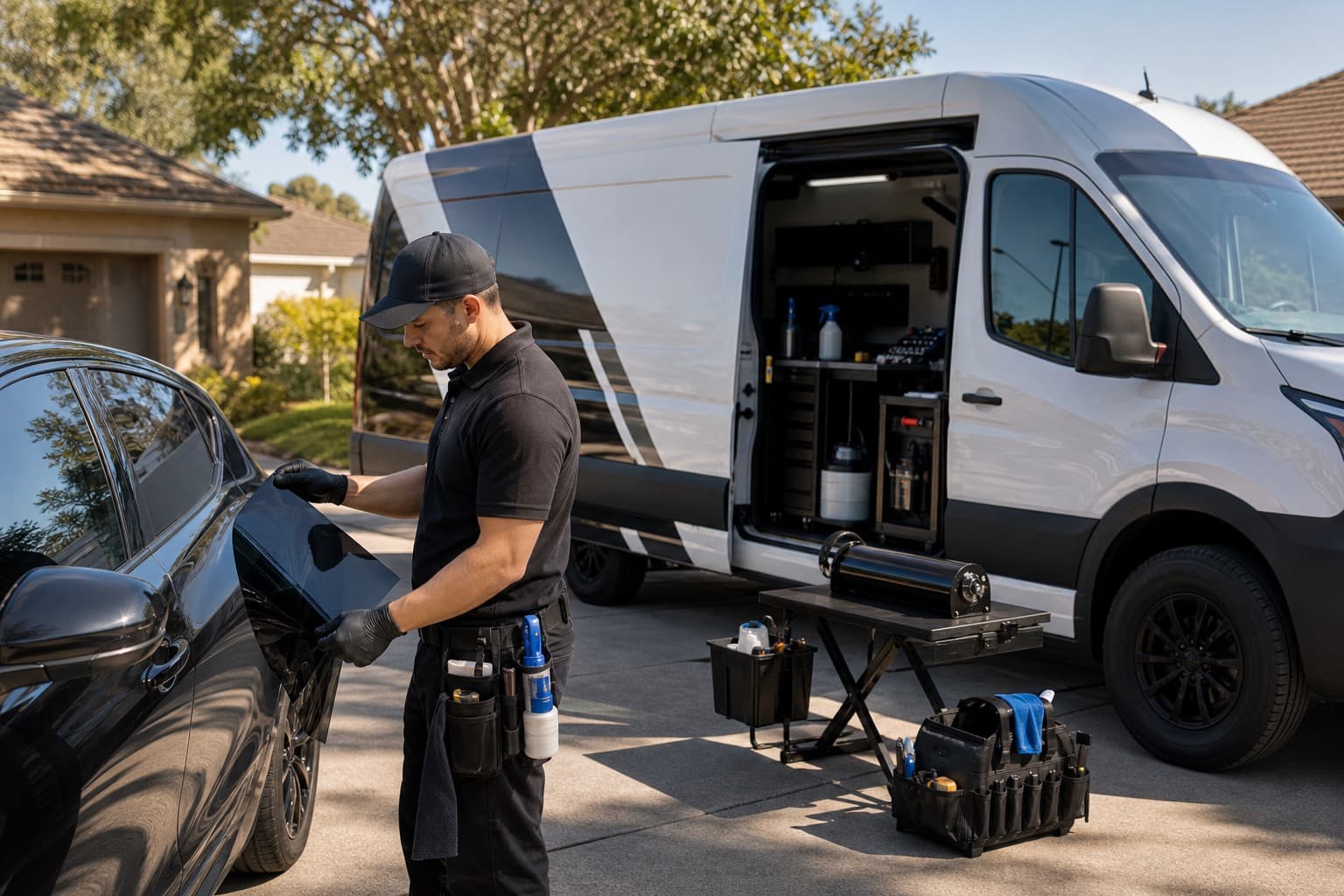
A lot of mobile window tint operators assume Google Maps and local SEO simply do not apply to them. No storefront, no address, no map pack ranking — right?
Wrong. Google has a specific business type built for exactly this situation, and mobile tint operators who set it up correctly often outrank storefront shops in the neighborhoods they actually serve. The problem is not that mobile businesses cannot rank. It is that almost nobody sets them up correctly.
Step 1: Set Up Your Google Business Profile as a Service Area Business
When you claim your Google Business Profile, you will be asked whether customers visit your business at its address. For a mobile operation, the answer is no. Select "I deliver goods and services to my customers" instead, and Google converts your listing into a Service Area Business (SAB).
What changes with an SAB listing: - Your exact address is hidden from public view (only your general area shows, like "serves Denver, CO") - You define a service area — either a radius from your base location or a list of specific cities/zip codes - You still appear in Google Maps searches and the local map pack within your defined area
The mistake almost every mobile tint operator makes: entering your home address as a public business address, or worse, entering a P.O. box that gets flagged and suspended. Do it the SAB way from day one — it is both compliant with Google's guidelines and better for your rankings.
Step 2: Define Your Service Area Strategically
Do not just select "50 mile radius" and move on. Google's own guidance recommends limiting your service area to roughly a 2-hour drive from your base, and more importantly, you want your service area to match how customers actually search.
List specific cities and neighborhoods rather than relying purely on radius targeting. If you serve Plano, Frisco, and McKinney around Dallas, add each by name. This directly improves your chances of ranking when someone in Frisco searches "mobile window tint Frisco."
Step 3: Build a Location Page for Every City You Serve
This is the single highest-leverage move for mobile tint marketing, and almost no one does it well. Instead of one generic "service area" paragraph on your homepage, build a dedicated page for each city:
- yourdomain.com/mobile-window-tint-frisco
- yourdomain.com/mobile-window-tint-mckinney
- yourdomain.com/mobile-window-tint-plano
Each page should include the city name in the title tag, H1, and naturally throughout the copy, along with: - A short intro mentioning specific neighborhoods or landmarks in that city - Your mobile process (how scheduling and on-site service works there) - Before/after photos from jobs actually completed in that city if you have them - A city-specific call to action
This is not keyword stuffing — it is giving Google (and your customers) genuinely useful, locally relevant content. Ten well-built city pages can out-rank a single storefront shop that only targets one location.
Step 4: Reframe Your Keywords Around Convenience
Storefront shops rank for "window tint near me." Mobile operators should be equally aggressive about a different set of searches that signal someone specifically wants a mobile service:
High-intent mobile keywords: - mobile window tint near me - window tint that comes to you - window tinting at my house - on-site car tint [city] - mobile auto tint [city] - window tint at my office
These searchers have already decided they want mobile convenience — they are not comparing you against a shop with a waiting room. Your ad copy and page content should lead with "we come to you" as the headline benefit, not bury it in a bullet point.
Step 5: Turn Your Van Into a Lead Source You Can Measure
Vehicle branding is free advertising every time you drive or park at a job site — but almost no mobile operator tracks whether it actually generates calls. Fix that:
- Use a dedicated phone number on your van (a call tracking number) so you know exactly how many calls come from vehicle branding versus your website
- Add a QR code that links directly to your booking page or Google review link
- Park visibly (with permission) in high-traffic areas while working, not tucked away
We have seen mobile shops discover that van branding was quietly generating 15–20% of their total leads once they started tracking it — money they would have otherwise attributed to "referrals" or "word of mouth."
Step 6: Reviews Matter Even More for Mobile Businesses
Without a physical storefront to build trust visually, reviews carry extra weight for mobile operators. Customers letting a stranger into their driveway or parking lot want extra reassurance.
Ask for the review on-site, immediately after the job, exactly like a storefront shop would — the only difference is you are standing in their driveway instead of your showroom. Mention in the review request that you noticed their specific vehicle and location: "Thanks for having us out to [neighborhood] today for your Tesla!" Specificity in the ask (and eventually in the review itself) builds trust for the next searcher.
Step 7: Google Ads Targeting for Service Area Businesses
When you run Google Ads without a storefront, use radius or zip-code targeting centered on the neighborhoods you actually want more jobs in — not just your home base. If one city is under-served by your current bookings, you can shift ad spend geographically without needing a second location.
Location extensions work differently for SABs since your address is not public, so lean on call extensions and a strong "service area" callout in your ad copy instead: "Mobile Window Tint — We Come to You in [City]."
Step 8: Address the Trust Gap Directly in Your Messaging
Some customers hesitate with mobile services because they are unsure what "mobile" really means logistically. Answer the obvious questions directly on your site and in your ads:
- How much space do you need to work? (Most jobs need a driveway or flat parking space with shade)
- How long does an on-site appointment take?
- What happens if it rains?
- Do you need access to power or water?
Answering these proactively removes friction that would otherwise cost you bookings from an otherwise interested customer.
The Bottom Line
A mobile window tint business is not a disadvantage in local search — it is a different setup that requires a different playbook. Claim your Google Business Profile as a service area business, build dedicated pages for every city you serve, lead with convenience in your messaging, and track every lead source including your vehicle branding. Mobile operators who do this consistently often out-rank and out-book storefront competitors in the exact neighborhoods that matter most.
Want us to handle this for you?
Start your free 14-day trial. We build and launch everything while you focus on tinting.
Start Free Trial